
You built your first trading app. You pulled a last price from a broker endpoint, maybe fetched a day of history. Things were going well.
Then you tried to do something useful: render an intraday chart for AAPL, show the full options chain for SPY, or stream live quotes across a hundred symbols at once. And you hit a wall. A raw exchange or venue feed doesn't hand you any of that in a form you can query. The data is there — millions of quotes and trades per second, spread across dozens of venues, each with its own format — but it isn't organized in any way an application can consume. This is the problem a market-data pipeline solves, and understanding it will save you months of wasted engineering.
This article explains what a market-data pipeline is, how it works, the different ways to get normalized market data, and how to decide whether to build your own or buy one.
The Problem: Why a raw feed isn't ready for applications
Say you want to display a simple OHLCV chart for a stock over the last trading day — the kind you see in every brokerage app.
Here's what you'd need to do with raw venue feeds:
- Subscribe to every venue that trades the symbol (multiple exchanges plus off-exchange reporting) and handle each feed's wire format
- Reconstruct a consolidated best bid/offer from the individual venue quotes
- Sequence and de-duplicate trades that arrive out of order across venues
- Apply corporate actions (splits, dividends) so historical prices stay comparable
- Aggregate everything into OHLCV candles at your chosen resolution
That's a firehose of messages per second, format-specific parsing that breaks whenever a venue changes its protocol, and a meaningful amount of infrastructure. For one symbol and one metric.
Now multiply that by every US-listed stock and ETF, full options chains, and a set of crypto and prediction-market venues on top. That is the problem a pipeline solves.
Here's what the raw approach looks like in pseudo-code:
// Step 1: Connect to every venue feed for this symbol
// Step 2: Normalize each venue's wire format into a common schema
// Step 3: Build a consolidated bid/offer, sequence trades, drop dupes
// Step 4: Apply splits and dividends to keep history comparable
// Step 5: Aggregate into OHLCV candles
// Step 6: Handle edge cases: halts, auctions, late prints, cancels
// ... hundreds of lines of code, a constant message firehose, fragile parsers
Now here's the same thing against a normalized market-data API:
// One GET returns a normalized, consolidated quote — no pipeline to build
const res = await fetch(
  "https://elgonrpc.xyz/api/v1/quotes?symbols=AAPL&key=elgon_sandbox_pub"
);
const { data, source } = await res.json();

console.log(data[0]); // { symbol, price, bid, ask, volume, asOf } — already consolidated
console.log(source);   // "live" — real data, delayed (not real-time)
One API call. No parsing. No infrastructure. The pipeline already did the hard work.
What Is a Market-Data Pipeline?
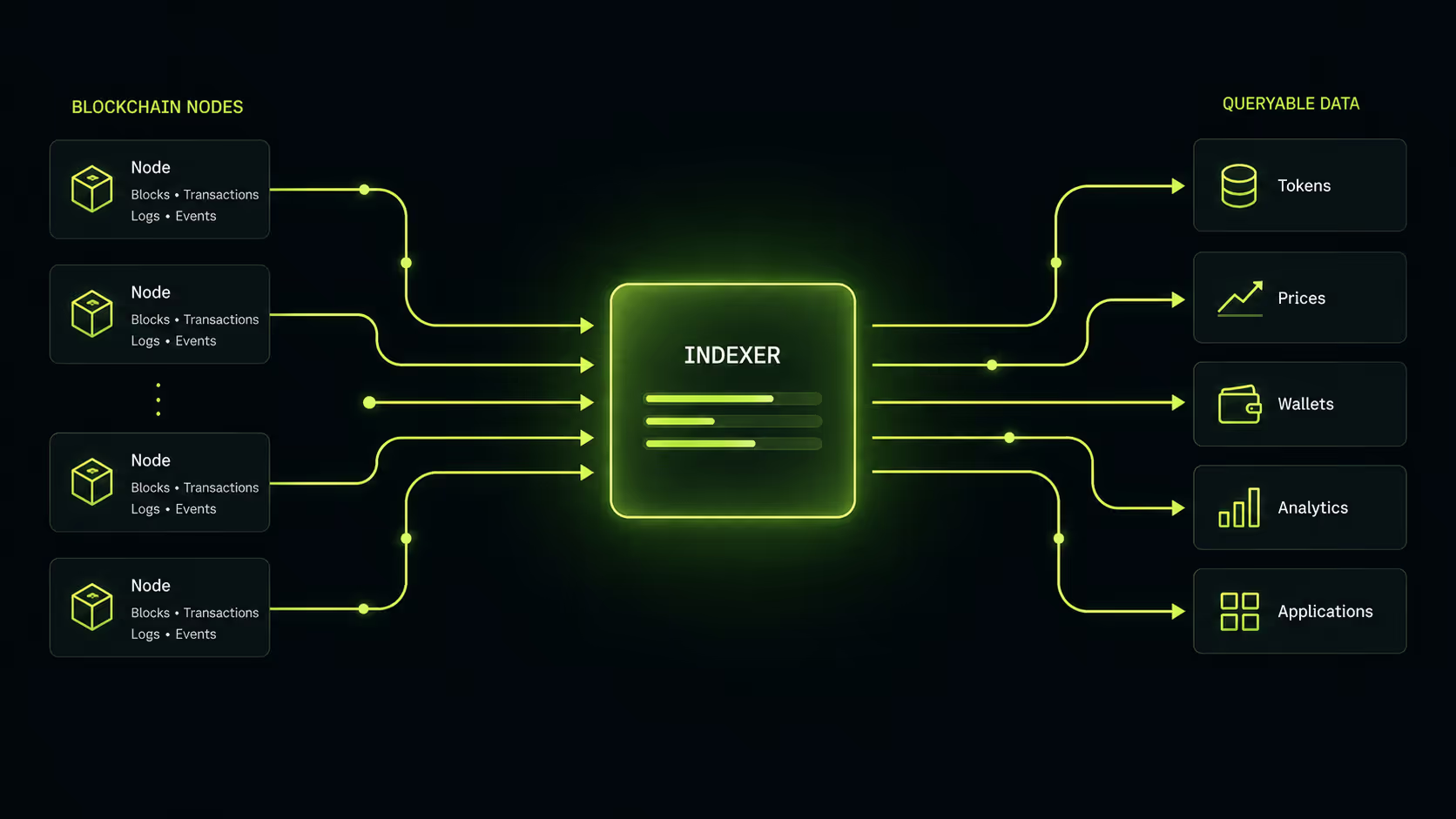
A market-data pipeline ingests raw feeds from exchanges and venues, processes them, organizes the result into structured formats, and makes it queryable through an API.
The concept is straightforward, even if the implementation is not.
Think of it this way: raw venue feeds are a stack of receipts arriving faster than you can read them, in a dozen different handwritings. A pipeline is the accountant who normalizes every receipt into one ledger, keeps running totals, and lets you ask "show me every trade in this symbol today" or "what was the price of SPY over the last week."
Here's what a pipeline does:
- Ingests every quote and trade from each exchange and venue as it is published
- Normalizes each venue's wire format into one common schema, so a message becomes "AAPL traded 100 shares at $187.42 on venue X at 14:30:01.220"
- Enriches the normalized data by building consolidated quotes, computing VWAP and volume, applying corporate actions, and deriving metrics that don't exist in the raw stream
- Stores the processed data in a queryable database (PostgreSQL, ClickHouse, a tick store, or similar)
- Serves the data through an API (REST, GraphQL, WebSocket), so your app can query it without touching venue feeds directly
The key insight is step 3: enrichment. A raw feed doesn't know what a "consolidated best bid/offer" is. It doesn't track "24-hour volume" or adjust for a stock split. These are derived values that require processing the raw stream, reconciling venues, and computing aggregates. This is what separates a raw feed from data you can actually build a product with.
Types of Market-Data Pipelines
There are three main approaches. Each trades off control, complexity, and cost.
Self-Hosted Feed Handlers
You run your own ingestion infrastructure: direct venue connections, feed handlers, a tick database, and an API layer.
Pros:
- Total control over processing and storage
- No third-party rate limits
- You capture exactly the data you need, nothing more
Cons:
- Expensive. Direct feeds, colocation, and redundant infrastructure add up quickly, often to six figures a year
- Complex to maintain: venue protocol changes, exchange holidays, gap recovery, and backfills never stop
- Requires deep market-data expertise on your team
- You own uptime, correctness, and freshness guarantees
Self-hosting makes sense when market data is your core product. For most teams, it's overkill.
Open-Source Frameworks
Libraries and frameworks (feed handlers, tick stores, streaming toolkits) give you building blocks for ingesting and storing data yourself.
Pros:
- No licensing lock-in, full transparency into how data is processed
- Composable — you assemble exactly the pipeline you want
- Active communities around the popular projects
Cons:
- You still have to source and pay for the underlying feeds
- You write and maintain the normalization and enrichment logic
- No built-in consolidated quotes, corporate actions, or SLAs — you build all of it
- Operational burden lands on your team
Open-source is a good fit if you have the engineering depth and a strong reason to own the stack. For most application developers, it's more plumbing than product.
Managed Market-Data APIs
A provider runs the entire pipeline, and you get access through an API. No infrastructure to manage, no normalization logic to write.
Pros:
- Fast to start: get an API key, make your first query in minutes
- Production-ready enriched data out of the box (consolidated quotes, OHLCV, corporate actions)
- Someone else handles uptime, freshness, and venue coverage
- SDKs, documentation, and developer support
Cons:
- Dependency on the provider's availability and roadmap
- Costs scale with usage
- Less flexibility for highly custom transformations
For most teams building trading and market apps, a managed API is the pragmatic choice. You trade some control for a large reduction in complexity and time-to-market.
Comparison Table
| Self-Hosted | Open-Source | Managed API | |
|---|---|---|---|
| Setup time | Weeks to months | Days to weeks | Minutes |
| Infrastructure cost | High (six figures+) | Feeds + your infra | Predictable subscription |
| Data enrichment | You build it | You build it | Included |
| Asset coverage | You add each venue | Limited by connectors | Stocks, ETFs, options, crypto, prediction |
| Corporate actions | You handle them | Not built-in | Included |
| Real-time data | Depends on your infra | Depends on your infra | Delayed (Elgon) |
| Maintenance burden | High | Medium | Low |
| Best for | Data vendors, custom needs | Teams that want to own the stack | Application developers |
Build vs Buy: When to Build a Pipeline Yourself
This is the decision most teams get wrong, and it usually costs them months of engineering before they realize it.
Build your own pipeline when:
- Market data IS your core product. You're a data vendor, and the pipeline is what you sell
- You need highly custom transformations that no API provides (proprietary analytics, a novel venue)
- You need absolute control over every step of processing and storage
- You have dedicated infrastructure engineers who can own the system long-term
Use a managed API when:
- You need market data to build your actual product — a trading platform, a portfolio tool, an options screener, or a bot
- Time-to-market matters. You can't spend months building a feed handler before building your app
- You want enriched data (consolidated quotes, OHLCV, corporate actions, aggregated volume) without building the enrichment yourself
- You don't want to maintain market-data infrastructure alongside your product
The honest math: a production-grade multi-venue pipeline is a standing commitment, not a one-time build. Venues change protocols, new asset classes appear, and your pipeline has to keep up. For most teams, that engineering time is better spent on the product.
If you're asking "should I build my own pipeline?", you probably shouldn't. The teams that need to build their own already know it.
How Elgon Approaches Market Data
Elgon is a managed market-data API. It serves consolidated quotes and instrument reference data through one simple REST endpoint, so you do not have to build and run a pipeline yourself.
Here's what that means in practice:
- Coverage: quotes and instruments for US-listed stocks and ETFs and major crypto assets; options and prediction-market (event) contracts are available as sandbox-simulated data
- Real but delayed: quotes are genuine market data, tagged
"source":"live"— delayed, not real-time or sub-second - Consolidated, not raw: you get a normalized quote (price, bid, ask, volume) instead of a multi-venue tape you have to assemble
- One delivery method: plain HTTP GET — no GraphQL, no WebSocket, no webhooks; poll on an interval for updates
- Signed, timestamped data receipts: every response carries a tamper-evident
sha256receipt you can verify yourself
This is what you get when market-data infrastructure is someone else's full-time job. Instead of building and maintaining your own pipeline, you get a single API call:
// One GET, no SDK — a consolidated quote for a symbol
const res = await fetch(
  "https://elgonrpc.xyz/api/v1/quotes?symbols=SPY&key=elgon_sandbox_pub"
);
const { data } = await res.json();
const q = data[0];
console.log(`${q.symbol}: ${q.bid} / ${q.ask} — last ${q.price} @ ${q.asOf}`);
Without a pipeline, you'd need to connect to each venue, normalize every message, reconstruct a consolidated quote, and keep it all correct through halts and corporate actions. That's a full-time infrastructure project. With a normalized API, it's one call.
For a deeper look at how market-data APIs compare, see our developer comparison of the best market-data APIs. If you're building on the Robinhood product surface specifically, our Robinhood API guide covers the full landscape of data providers.
Getting Started
Where you go from here depends on where you are:
- If you're exploring: read the Elgon documentation to see the full range of available data — quotes, OHLCV bars, options chains, corporate actions, and streaming feeds.
- If you're building: get a free API key and make your first query. The SDK gets you from zero to working code in minutes.
- If you're migrating from a home-grown feed handler: Elgon typically replaces custom ingestion with standard API calls. No venue connectors to maintain, and the enrichment (consolidated quotes, corporate actions) you'd normally build yourself is already included.
FAQ
What is a market-data pipeline?
A market-data pipeline is software that ingests raw feeds from exchanges and venues, normalizes and enriches them into structured formats, and serves them through a queryable API. It turns an unstructured message firehose into something applications can use directly, such as consolidated quotes, OHLCV bars, options chains, and trade history.
What is the difference between a market-data pipeline and a raw feed?
A raw feed gives you direct access to a venue's messages — quotes and trades in that venue's wire format. It can answer simple questions about that one venue's current state. A market-data pipeline processes those feeds across venues and lets you ask richer questions like "what was the price of this symbol over the last 24 hours?" or "show me the full options chain right now." Those queries require consolidating and enriching a huge volume of messages — something a raw feed was never designed to do.
Do I need a market-data pipeline?
If your app needs any of the following, you need normalized market data: consolidated quotes, price charts (OHLCV), volume, options chains, symbol search or screening, portfolio valuation, or real-time trade feeds. If you only need an occasional last price for one symbol, a simple endpoint may be enough. Most trading and market apps beyond that need a real pipeline.
How much does it cost to build a market-data pipeline?
A production-grade multi-venue pipeline is a significant, ongoing investment — direct feeds, redundant infrastructure, and the engineering time to keep normalization and corporate actions correct. Managed APIs like Elgon start with a free tier and scale on usage, eliminating that overhead entirely.
What are the best market-data pipelines?
The best option depends on your needs. For most application developers, a managed API like Elgon (stocks, ETFs, and crypto through one endpoint, with real but delayed data — options and predictions are sandbox-simulated) is the fastest path to production. If you have the engineering depth and a reason to own the stack, open-source feed handlers and tick stores are solid building blocks. Full self-hosting makes sense mainly for dedicated data vendors.
Skip the plumbing. Start with normalized data. Get an API key and follow along with the code examples in this guide.